
Let’s talk about abdominal bloating. And yes, we can feel half of you instinctively sitting up straighter already, while the other half is thinking, “Ah. This again.”
Globally, this puffy little menace affects millions of people. In fact, depending on where you look, anywhere from roughly one in six to nearly one in three adults deal with a bloated stomach regularly. Moreover, if you have irritable bowel syndrome (IBS), congratulations, ninety percent of us are on this together.
What makes bloating especially frustrating is its unpredictability. While you might assume medicine has this sorted out by now, it absolutely does not. Neither eating less nor eating more fiber seems to work all the time. So naturally, you’re confused and probably slightly angry.
In this article, we are going to unpack what causes bloating, what it feels like, and why it keeps happening. We will also explore what actually helps and what is mostly nonsense.
What is a bloated stomach?
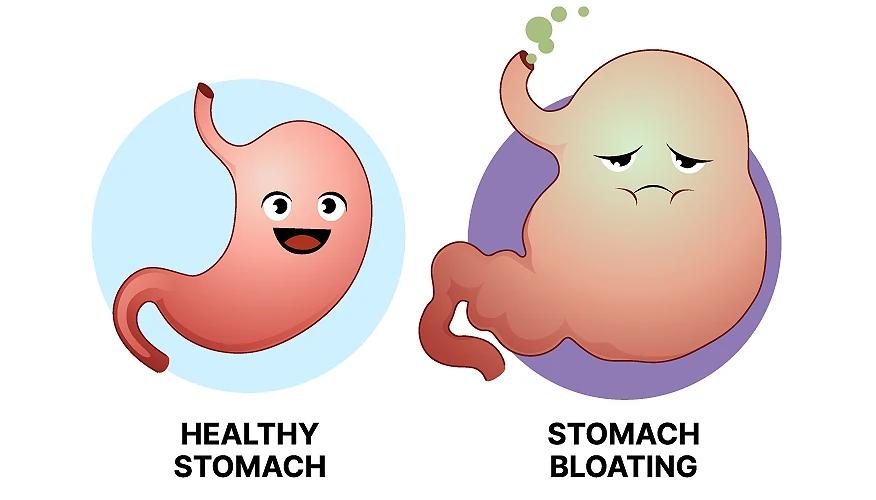
Medically speaking, a bloated stomach is not your belly physically ballooning, but the feeling that your abdomen is fuller, tighter, or under suspicious internal pressure.
It is the sensation that something is happening in there. You may feel heavy or uncomfortable, but nothing may look different externally.
That is where distension comes in. Distension is when the stomach actually expands in a visible, measurable way. In extreme cases like constipation, the abdomen can expand by up to twelve centimeters.
While bloating and distension sound like they should be the same thing, they absolutely are not. In fact, only about half of the people who feel bloated actually develop visible distension. The rest of us are just walking around, feeling like our protruding stomach has further betrayed us.
According to the Rome IV diagnostic criteria, functional bloating means you feel bloated or look distended at least three days a month, and this has been happening for six months or more.
Common causes of a bloated stomach
For years, we were told that we are bloated because we have too much gas. But, actually, no, that is wildly incomplete.
People with IBS and functional bloating produce roughly the same amount of gas as everyone else, which is about 700 milliliters a day. This is more about impaired gas handling, altered sensory perception, and dysfunctional abdominal mechanics:
1. Gas production and fermentation
Certain carbohydrates are poorly absorbed in the small intestine. Therefore, they continue their journey into the colon, where they perform endogenous hydrogen, methane, and carbon dioxide gas production—causing bloating.
These carbohydrates are known as foods high in fermentable oligosaccharides, disaccharides, monosaccharides, and polyols (FODMAPs). They show up in foods that are common across Asia, including noodles, breads, garlic, onions, certain fruits, and dairy.
Fructose malabsorption and sensitivity to wheat-based fructans also contribute, particularly in modern diets where portion sizes have quietly grown while our enzymes have not kept up.
2. Small intestinal bacterial overgrowth (SIBO)
Instead of waiting in the colon, excess bacteria colonize the small intestine, where they begin fermenting food far too soon. This leads to gas production earlier in digestion, which your body is very bad at hiding.
SIBO is more common in people with prior gastrointestinal surgery, motility disorders, celiac disease, or long-term use of acid-suppressing medications.
Breath tests suggest wildly variable prevalence in IBS patients, ranging from 4 percent to practically everyone, leaving room to call the diagnosis controversial.
3. Impaired gas transit and clearance
As mentioned, the production of gas is not the culprit here, but the unfair handling of it is.
About 90 percent of IBS patients retain intestinal gas, while only about 20 percent of healthy individuals do. That means gas that should move along politely instead stalls, loiters, and refuses to leave.
Transit through the intestines is often slower in people who bloat, while reflexes that normally push gas forward do not fire correctly. If you’re constipated, this makes it worse because your stool sits longer, fermentation continues, and gas production quietly compounds.
4. Visceral hypersensitivity
At a more advanced recurring state, your gut nerves may overreact to normal levels of stretching and gas. What should feel like mild pressure instead registers as pain or severe discomfort. This is a defining feature of disorders of gut-brain interaction (DGBI), such as functional dyspepsia.
However, studies show that more than one-third of people with stomach bloating have normal sensory testing, which means sensation alone cannot explain everything.
5. Abdomino-phrenic dyssynergia
In healthy digestion, when gas increases, the diaphragm relaxes upward, and the abdominal muscles tighten. The abdomen stays relatively flat. Everyone goes on with their day.
In functional bloating, the reflex flips. The diaphragm contracts and moves downward while the abdominal wall relaxes and bulges outward. This happens even when the gas volume is modest. Imaging studies confirm that visible distension in these patients is often driven more by muscle coordination failure than by actual gas load.
Symptoms of a bloated stomach
Stomach bloating symptoms usually depend on the reason it has developed. Some common symptoms include:
- You feel uncomfortably full, tight, or heavy, even after small meals.
- Abdominal pain that ranges from mild annoyance to sharp cramps.
- Your belly visibly protrudes, usually worsening by evening.
- Burping, flatulence, constipation, or diarrhea may appear.
- Flatulence or passing gas (14 to 18 times daily in healthy individuals, more in bloating)
Foods that can cause a bloated stomach
Foods that trigger stomach bloating are primarily those high in FODMAPs or that produce excess gas. For example:
- High FODMAP vegetables like garlic, onion, leeks, asparagus, mushrooms, cauliflower, sweet corn, etc.
- High FODMAP fruits like apples, apricots, avocados, cherries, guava, lychee, etc.
- Wheat and rye products containing fructane, like pasta and cereals.
- Beans, lentils, chickpeas
- Dairy products
- Sorbitol, Mannitol, Xylitol, and high fructose corn syrup
How to relieve a bloated stomach quickly
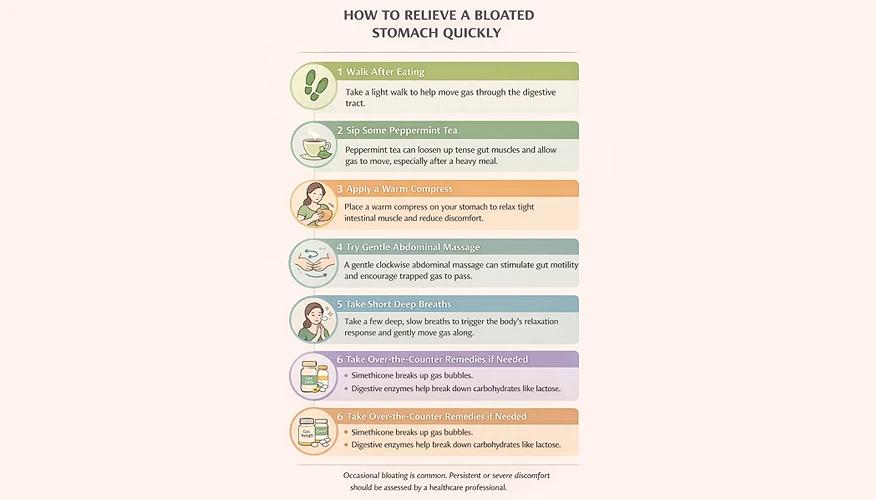
Here are a few ways that can help you relieve a bloated tummy quickly:
1. Foods to reduce bloating
- Bloating can be eased with foods like pineapple and papaya, which contain enzymes that politely dismantle meals.
- Kiwis, ginger, and peppermint further calm your digestive system.
- Cooked vegetables and yogurt stop fermentation from turning your insides into a hot air balloon.
2. Natural bloating remedies
- Ginger tea, peppermint tea, and fennel tea relax cramped muscles and help gas exit with ease.
- Enzyme supplements and probiotics can also help if your dinner was overly ambitious.
3. Exercises that help reduce bloating
- Walking after meals works absurdly well. Yoga twists and knee-to-chest poses physically escort trapped gas toward the exit.
- Breathing slowly can stop your nerves from overreacting and calm down the digestive system.
- Additionally, yoga poses such as the Knee-to-Chest Pose, Supine Spinal Twist, and Garland Pose can help.
4. Lifestyle changes to prevent a bloated stomach
Slower eating, dividing your meals into smaller portions, stress reduction, and weight loss all contribute towards a healthier gut and a reduced bloated stomach.
Conclusion
Bloating is your body reacting, sometimes loudly, to food, stress, or slow digestion, which can be confusing. However, once you understand what is happening, things often feel less scary and more manageable.
Luckily, we can gently help our gut over time. By eating more slowly, choosing calmer foods, moving our bodies, and lowering stress, we often feel better. Progress is rarely instant. However, small changes done consistently really do add up.
Meet our expert

GHBY Team
GHBY TeamMeet our expert
GHBY Team comprises content writers and content editors who specialise in health and lifestyle writing. Always on the lookout for new trends in the health and lifestyle space, Team GHBY follows an audience-first approach. This ensures they bring the latest in the health space to your fingertips, so you can stay ahead in your wellness game.



How was the experience with article?
We'd love to know!